AuthorLeila Wu

DateFeb 4, 2026
Reading time5 min read
Return on Experience
It’s getting harder for brands to not only make an impact but also measure that impact.
In a world of endless noise and ever-evolving consumer expectations, marketers must strike a delicate balance: they need to drive innovation at the speed of culture while staying grounded in authenticity, consumer-centricity, and efforts to grow community.
Traditional marketing metrics are often failing to paint the full picture when it comes to measuring the value of modern tactics. Brands must find new ways of measurement that account for not only short-term performance, but also long-term impact on brand equity, customer loyalty, cultural relevance, and sales.
Experience has emerged as the most powerful way to create meaningful connection. By inviting audiences to participate in immersive, personalized IRL experiences that show the brand’s values in action, brands create opportunities to forge unique and lasting memories that hold real emotional resonance.
What do we mean when we say "Experience"?
“Experiences allow the audience to be the main character in a way that other tactics will never be able to do. In an experience, you are the hero: you get to keep that memory, and you never forget how it makes you feel. ”
Michelle Higa Fox
Group Creative Director, BUCK
Experience is a holistic and audience-centric way of thinking about real-world, in-person activations. Experience is not just the event itself, nor the content generated from it; it encompasses the methods used to make that event an emotionally-resonant memory for participants that extends well beyond any tentpole moment.
Experience has the power to transcend into culture. In the strongest cases, when a brand’s values align clearly and authentically with its audience, an experience transcends the temporary moment and enters culture, becoming a shared reference point in our collective consciousness. This generation of cultural capital unlocks long-term brand equity that performance metrics simply cannot replicate.
Being able to accomplish this requires new ways of thinking, creating, and measuring experience itself.
However, measuring experience is notoriously difficult. Forcing traditional marketing metrics onto experience to quantify its qualitative aspects like emotional resonance, brand advocacy, and memory retention is akin to forcing a square peg into a round hole. Such exercises often yield weak data, resulting in inconsequential insights and devaluing experience.
If we measure experience just like media, it will always fall short. We enter what WARC calls an "advertising doom loop," optimizing for faulty metrics and prioritizing short-termism with our brand investments. Without a clear understanding of brand objectives and a structured framework for meaningful measurement, making the case for investing in experience becomes a huge challenge for marketers.
Introducing: The Return on Experience (ROX) Framework
To address this, we have developed the Return on Experience (ROX) Framework to help marketers and organizations invest in experiences effectively.
While technology and culture are transforming the role of experience in marketing, the Return on Experience (ROX) Framework is built upon two fundamental shifts and concepts:
- Experience can create more holistic value than just marketing value and shouldn’t be measured as “media” alone.
- Experience must scale to achieve maximum impact and therefore our ways of measurement should expand as well.
The framework expands in two directions: the vertical axis measures holistic brand value, from brand lift and audience engagement to sales, PR, and organizational insight. The horizontal axis represents time — before, during, and after the experience — turning every activation into a bell curve of compounding impact.
“"We measure things not for vanity, but to be able to learn and make things better. That means designing an approach to uncover foundational insights that can impact more than marketing, but product, sales, and even our notion of who a customer is."”
Jim Babb
CEO
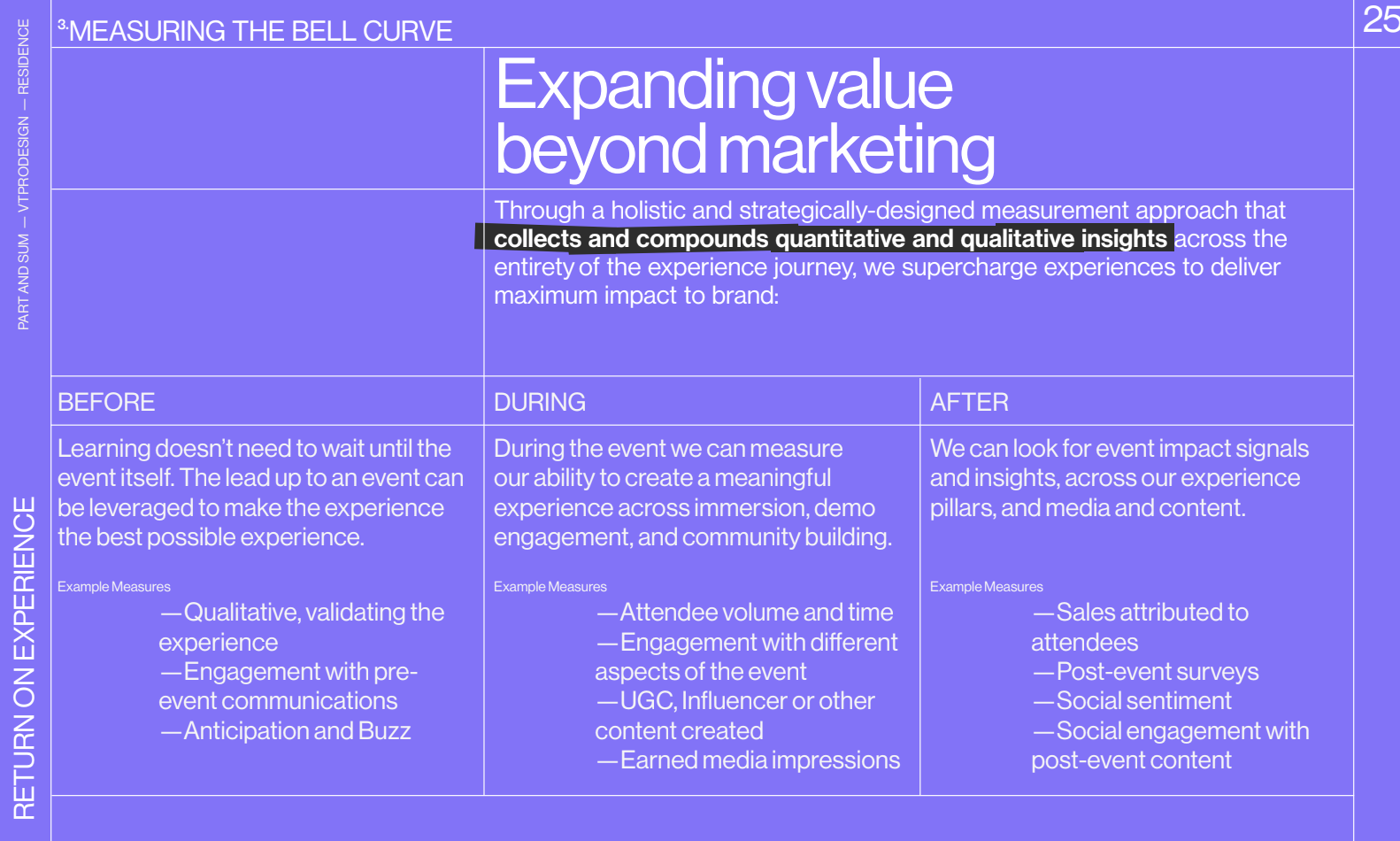
In Sum: ROX is the new ROI for experience.
From retail activations to touring exhibitions, the strongest brands today don’t just market to audiences; they invite them into their world, co-create with them, and show up consistently across different moments and mediums.
The best experiences:
- Move from transactional to transformative
- Invite active participation
- Blend physical and digital
- Create shared cultural moments
- Embed themselves in memory, not just media
Most importantly, when experience is treated as a strategy and not just another disposable activation, it has the power to generate vast return on experience, measured in value across marketing, brand, sales, and organizational growth.
To download the report, click here.
Related Insights
If you liked thisyou'll love 😍 these too